
The U.S. to Suspend Immigrant Visa Processing for 75 Countries
The Department of State (DOS) announced that it is undergoing a full review of all policies, regulations, and guidance to ensure that immigrants from high-risk countries do not utilize welfare in the United States or become a public charge. The suspension comes after DOS directed increased scrutiny under the “public charge” provision of immigration law meant to target those who the administration believes will become a strain on public resources.
Effective January 21, 2026, the DOS is pausing all visa issuances to immigrant visa applicants who are nationals of the following countries:
Afghanistan, Albania, Algeria, Antigua and Barbuda, Armenia, Azerbaijan, Bahamas, Bangladesh, Barbados, Belarus, Belize, Bhutan, Bosnia and Herzegovina, Brazil, Burma, Cambodia, Cameroon, Cape Verde, Colombia, Cote d’Ivoire, Cuba, Democratic Republic of the Congo, Dominica, Egypt, Eritrea, Ethiopia, Fiji, The Gambia, Georgia, Ghana, Grenada, Guatemala, Guinea, Haiti, Iran, Iraq, Jamaica, Jordan, Kazakhstan, Kosovo, Kuwait, Kyrgyz Republic, Laos, Lebanon, Liberia, Libya, Moldova, Mongolia, Montenegro, Morocco, Nepal, Nicaragua, Nigeria, North Macedonia, Pakistan, Republic of the Congo, Russia, Rwanda, Saint Kitts and Nevis, Saint Lucia, Saint Vincent and the Grenadines, Senegal, Sierra Leone, Somalia, South Sudan, Sudan, Syria, Tanzania, Thailand, Togo, Tunisia, Uganda, Uruguay, Uzbekistan, and Yemen.
The immigrant visa process is the last step in the green card process for applicants applying from outside the United States. Immigrant visa applicants who are nationals of impacted countries may still submit visa applications and attend interviews. The Department will continue to schedule applicants for appointments, but immigrant visas will not be issued to these nationals during this pause.
Note, this pause is specifically for immigrant visa applicants. Nonimmigrant visas, including L-1s, H-1Bs, and O-1s, are not subject to this pause. Importantly, this will not prevent an applicant who is a national of an affected country from filing an Adjustment of Status (Form I-485) application from within the United States to complete their green card process.
USCIS to Increase Premium Processing Fees
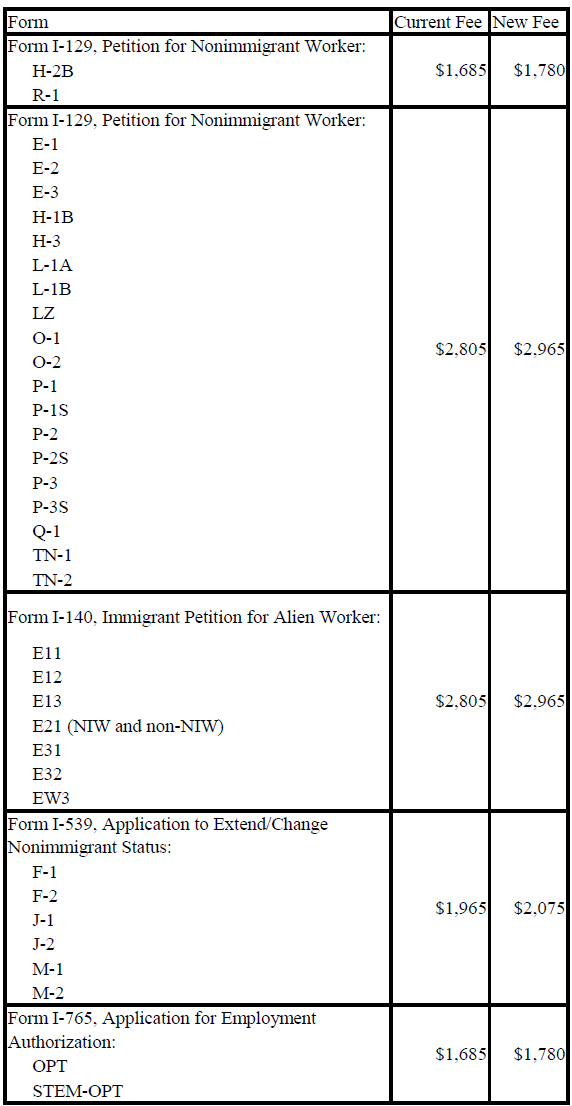
On January 12, 2026, the Department of Homeland Security (DHS) published a final rule that will increase U.S. Citizenship and Immigration Services (USCIS) fees for premium processing to reflect the amount of inflation from June 2023 through June 2025.
The USCIS Stabilization Act established the authority for DHS to adjust premium processing fees every two (2) years to account for inflation. The revenue generated by this fee increase will be used to provide premium processing services, make improvements to adjudication processes, respond to adjudication demands, including processing backlogs, and otherwise fund USCIS adjudication and naturalization services.
This rule is effective on March 1, 2026. If an applicant submits a request for premium processing postmarked on or after March 1, 2026, they must include the new fee for the specific benefit they are requesting. Until then, an applicant can continue to submit their request for premium processing with the current fee for the specific benefit they are requesting.
Update on Presidential Proclamation Limiting Entry of Certain H-1B Nonimmigrant Workers
U.S. Citizenship and Immigration Services (USCIS) has issued updated guidance on the implementation of President Trump’s September 21, 2025, proclamation, which imposes a $100,000 fee on certain H-1B nonimmigrant worker petitions.
The $100,000 fee applies to the following H-1B petitions filed at or after 12:01 A.M. Eastern Daylight Time (EDT), September 21, 2025:
- Petitioners filing new H-1B petitions on behalf of beneficiaries who are outside the U.S. and who do not already hold a valid H-1B visa.
- Petitioners filing H-1B petitions on behalf of beneficiaries inside the U.S. that are requesting consular notification, port-of-entry notification, or pre-flight inspection.
- H-1B petitions filed on behalf of beneficiaries inside the U.S. that are requesting an amendment, change of status, or an extension of stay and USCIS denies such request.
The $100,000 fee does not apply to:
- Beneficiaries with previously issued and currently valid H-1B visas.
- H-1B petitions filed before 12:01 A.M. EDT on September 21, 2025.
- H-1B petitions filed on behalf of beneficiaries inside the U.S. at or after 12:01 A.M. EDT on September 21, 2025, that are requesting an amendment, change of status, or an extension of stay and USCIS approves such request. Additionally, a beneficiary of such petition will be exempt from the payment if he or she subsequently departs the U.S. and applies for a visa based on the approved petition and/or seeks to reenter the U.S. on a current H-1B visa.
Importantly, the proclamation does not restrict travel to and from the U.S. for current H-1B visa holders or beneficiaries of approved petitions. However, if a petitioner requests an amendment, change of status, or extension of stay, the beneficiary should remain in the U.S. until the petition is approved. Departing the U.S. before approval will result in denial of the petition by USCIS, and the petitioner will be required to pay the $100,000 fee.
Petitioners should submit the required $100,000 payment via pay.gov prior to filing the petition with USCIS. Proof of payment or exception must be included with the petition submission. Petitions submitted without proof of payment or exception will be denied.
Exceptions may be granted by the Secretary of Homeland Security in extraordinarily rare circumstances. Petitioners may request an exception from the Secretary of Homeland Security if the following criteria are met:
- The beneficiary’s presence is in the national interest.
- No qualified U.S. worker is available to fill the role.
- The beneficiary does not pose a threat to U.S. security or welfare.
- Requiring the petitioner to make the payment on the beneficiary’s behalf would significantly undermine the interests of the U.S.
Requests for exemption should be submitted with supporting documentation to H1BExceptions@hq.dhs.gov.
Note: Litigation challenging the legality of the $100,000 fee is currently ongoing.
Gold Card
On September 19, 2025, President Trump signed an Executive Order to create the Gold Card visa program, facilitating expedited immigration for aliens who make significant financial gifts to the United States. The Order directs the Secretary of Commerce, in coordination with the Secretaries of State and Homeland Security, to establish a “Gold Card” program.
The program facilitates expedited immigrant visas for aliens donating $1 million individually or $2 million if paid for by a corporation (or similar entity) on behalf of an individual. The Order instructs that these gifts serve as evidence of exceptional business ability and national benefit, expediting adjudication consistent with legal and security concerns. The Order directs the Secretary of Commerce to deposit the gifts into the Treasury and use them to promote commerce and American industry.
The program is designed to attract wealthy foreigners to the United States. According to the Trump administration's official website for the Gold Card, individuals can receive US residency in "record time" if they:
- Pay a $15,000 process fee to the Department of Homeland Security.
- Submit application materials and receive background approval.
- Make a $1 million gift to the U.S. Department of Commerce.
Note, an individual may also need to pay small, additional fees to the U.S. DOS depending on their circumstances. Prospective Gold Card holders can also include their spouses and children on their application for an additional $1 million, in addition to $15,000 in DHS fees per person.
In November 2025, U.S. Citizenship and Immigration Services (USCIS) introduced Form I-140G, Immigrant Petition for the Gold Card Program. Form I-140G is the first step in the Gold Card process – an individual or a corporation (or similar entity) on behalf of an individual may file this petition under the Gold Card program for the following immigrant visa classifications:
- An alien of extraordinary ability under 203(b)(1)(A) of the Immigration and Nationality Act.
- An alien of exceptional ability under 203(b)(2)(B) of the Immigration and Nationality Act who is seeking an exemption of the requirement of a job offer in the national interest (generally known as a National Interest Waiver or NIW).
If the applicant is requesting classification as an alien of exceptional ability who is seeking an NIW, they must also submit an uncertified Form ETA-9089, Application for Permanent Employment Certification, with their supporting evidence.
Once the petition is approved and there is an immigrant visa number available in the requested employment-based classification, the applicant must complete consular processing with the U.S. DOS at an Embassy or Consulate to secure their immigrant visa and travel to the U.S. to be admitted as a Lawful Permanent Resident (LPR). Once admitted as an LPR, the applicant’s Gold Card will be generated and issued.
Enhanced Visa Screening
Federal immigration agencies, including U.S. Citizenship and Immigration Services (USCIS), U.S. Customs and Border Protection (CBP), and the DOS, have signaled more stringent and security-focused approaches to U.S. immigration policy. These enhanced screening measures have resulted in increased visa revocations and processing delays. As such, applicants should anticipate heightened scrutiny applied to their visa applications, longer processing times, and potential disruptions to planned travel and visa renewals.
As part of the increased security vetting process, the U.S. government has broadened its screening protocols to include social media and online public activity of H-1B and H-4 applicants. These nonimmigrant visa applicants join the list of students and exchange visitors (F, M, and J) already subject to this expanded review. DOS has been instructing applicants to adjust the privacy settings on their social media accounts to “public.” Applicants should therefore review their social media accounts and other public content prior to their visa appointments. Delays in visa interviews as well as potential initial refusals may also increase as officers incorporate online activity into reviews.
End to Automatic Extension of Employment Authorization Documents
On October 29, 2025, USCIS announced the Removal of the Automatic Extension of Employment Authorization Documents Interim Final Rule (IFR), which ended the 540-day automatic extension of employment authorization documents (EADs) for applicants who timely filed their renewal applications (Form I-765) would become effective October 30, 2025. This automatic extension period previously provided was an important stopgap for employers to continue employing current employees in case it takes more than six (6) months to adjudicate their EAD renewal applications. Processing times can vary depending on the category of the EAD.
Some notable categories that no longer have access to the 540-day automatic extension after October 30, 2025, include, but are not limited to:
- Individuals granted refugee status.
- Individuals granted asylum status.
- Individuals who have been granted Temporary Protected Status (TPS).
- Spouse of a principal E nonimmigrant.
- Spouse of a principal L-1 nonimmigrant.
- Individuals with pending asylum applications.
- Adjustment of status applicants under Section 245 of the Immigration and Nationality Act.
- Spouses of certain H-1B nonimmigrants on H-4 nonimmigrant status.
- Individuals who petition for legal status as specified in the Violence Against Women Act (VAWA).
This latest change could severely impact U.S. employers looking to hire and retain employees who depend on an EAD. Prior to October 30, new hires using an EAD to complete their I-9 Form could present an EAD card past its expiration date so long as they had the appropriate accompanying documentation indicating a renewal had been applied for, and an automatic extension was granted. However, going forward, any renewal application must be dated prior to October 30, 2025, in order for an automatic extension to apply. Otherwise, those impacted will need an unexpired EAD card in hand to be eligible for hire and/or to continue working.
Employers with current EAD employees should be aware of their employees’ work authorization expiration dates. USCIS recommends applicants file an EAD renewal application up to 180 days before their EAD expires. Employees with upcoming expiration dates who have not applied for a renewal of their EAD risk the continuity of their employment.
The Importance of I-9 Compliance for Employers
Consistent I-9 processes during the employee onboarding process help employers stay compliant with federal laws.
Employers must use Form I-9 to verify the identity and employment authorization of individuals hired for employment in the United States. This includes any employee who is on payroll, whether full-time or part-time. Employers must complete Form I-9 for each employee no later than the first day of employment. Employers must keep records of such verification.
Employers must make their Form I-9s available for inspection if requested by authorized U.S. government officials from the Department of Homeland Security (DHS), Department of Labor (DOL), or Department of Justice (DOJ).
I-9 audits can also help identify any EADs with upcoming expiration dates so employers can communicate with employees before it becomes an issue. For more I-9 information and resources, please visit USCIS I-9 Central website: https://www.uscis.gov/i-9-central.
Recent Impacts to TPS Designations Per Country
Venezuela
On October 3, 2025, the Supreme Court allowed the termination of the 2023 Venezuela TPS designation to take immediate effect.
What this means for Forms I-766, Employment Authorization Documents (EADs):
- For beneficiaries of the 2021 Designation for Venezuela TPS who do not have an EAD or Form I-94, Arrival-Departure Record, with an October 2, 2026, expiration date, their TPS and employment authorization terminated on November 7, 2025.
- EADs with a category A12 or C19 and a “Card Expires” date of September 10, 2025, March 10, 2024, or September 9, 2022, issued under the 2021 TPS designation of Venezuela were automatically extended until November 7, 2025.
- Employers must reverify TPS Venezuela beneficiaries who presented these EADs before they start work on Nov. 8, 2025.
- With a timely filed EAD renewal application, EADs with a category A12 or C19 and a “Card Expires” date of September 10, 2025, or April 2, 2025, for TPS beneficiaries who re-registered under the January 17, 2025, extension notice may still be automatically extended for up to 540 days.
- Employees must present their Form I-797, Notice of Action indicating their Form I-765, Application for Employment Authorization, EAD renewal application was received before February 6, 2025.
Haiti
The Secretary of Homeland Security has terminated the TPS designation for Haiti. TPS benefits will no longer be in effect starting February 3, 2026.
Honduras, Nicaragua, and Nepal
A California federal district court has ruled that the DHS terminations of TPS for Honduras, Nicaragua, and Nepal were unlawful and has vacated the terminations.
As the TPS designations for these three countries have already expired and none of the countries have been redesignated for TPS, there is currently no active TPS designation for Honduras, Nicaragua, or Nepal.
Disclaimer:
This blog is a form of attorney advertising. Hodgson Russ LLP provides this information as a service to its clients and other readers for educational purposes only. Nothing in this blog should be construed as, or relied upon, as legal advice or as creating a lawyer-client relationship.
 Senior Associate
 Senior Associate
 Associate


